

























The 5 Classics of Cycling
First of all: There is no official definition of which races are counted as Classics. Historic cycling races in general are sometimes referred to as Classics or semi-classics, though not without disagreement.
However, there are the undisputed “Classics” – one-day races that are more important than all others. What they share is that their first edition took place before the First World War. In the case of the Tour of Flanders, the first edition was held in 1913 and could only be repeated once before it had to pause due to the war.
Precisely because of the disagreement around the term “Classics,” the label “The 5 Monuments of Cycling” became popular as a clearly descriptive alternative. The International Cycling Union (UCI – Union Cycliste Internationale), however, does not use either term in its official rulebook.
All Monuments have one thing in common: they are the longest and toughest one-day races of the year, and simply finishing one of these races presents athletes with enormous challenges. None of the Monuments is shorter than 250 km, and each has unique additional difficulties that make it so incredibly hard. These can lie in the elevation profile, as in Liège–Bastogne–Liège or the Tour of Lombardy, or in the road surface, as in Flanders and Roubaix.
Precisely because of these differing demands, it is almost impossible to win all five Monuments. Only three men (all from Belgium) have managed to do so in the past: Rik van Looy, Roger de Vlaeminck, and the legendary Eddy Merckx.
These are the 5 Monuments of Cycling:
Milan–San Remo
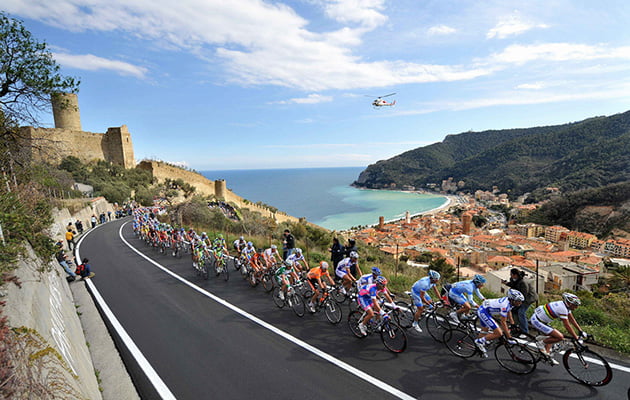
With the nickname la primavera (“the spring”), it is no surprise that Milan–San Remo is traditionally the Monument that appears earliest in the cycling calendar. Sometimes, it is therefore also referred to as the prima vera corsa, the “first real race.”
First held in 1907 under the harshest climatic conditions, the organizers were not sure whether the race could even be physically completed. Of the 33 riders, only 14 managed to cover the 286 kilometers to the finish.
Particularly challenging—and thus legend-making—was the 1910 edition, which took place during a severe snowstorm. Riders repeatedly had to seek shelter in houses along the route. Only four of the original 63 riders reached the finish. The winner, Eugène Christophe, had to spend four weeks in hospital to treat hypothermia and frostbite.
Today, the race is fortunately much safer, though still highly demanding in sporting terms. Because of its long flat sections, the race is considered one for sprinters.
Even though MSR is the longest race on the cycling calendar, its relatively easy course until about 60 km before the finish often produces little excitement in the first hours and shifts the focus to the beautiful Riviera coastline. The final hour, however, with its legendary short climbs known as the Capis, is for many the most thrilling hour of the year. For a long time, the race was known as the sprinters’ Monument, but in recent years these Capis—especially the Cipressa and the Poggio—have been ridden so hard that only small groups or even solo riders like Vincenzo Nibali have arrived, whose victory Q36.5 dedicated an exclusive jersey to.
The next edition of Milano–San Remo will take place on March 21, 2026.
Review 2025 Milan–San Remo
As in 2024, the race did not start in Milan but in Pavia, around 30 kilometers south of the metropolis.
At a distance of 287.20 kilometers, the 116th edition was even slightly shorter than last year’s route, while the traditional course with the Passo del Turchino, the Cipressa, and the Poggio remained unchanged.
Three exceptional riders, one finish line, one winner: Mathieu Van der Poel! A royal finale, epic beyond words: Van der Poel narrowly beat Ganna, while Pogačar once again missed out and continues to chase his dream of a San Remo victory.
What came before this showdown was pure cycling drama. The three turned the 5.6 km climb into a high mountain, smashed the nine-minute record, and then plunged down the descent as if riding a team time trial. Especially with the nearly 90 kg Ganna, it is hard to believe how he can hold the wheels—yet the pain is visible in every grimace.
Pogačar knows he has to get over the Capis on his own. In a sprint he has hardly any chance against the other two, who are significantly stronger. That’s why his team goes full gas on every little hill to force a decision by the Cipressa. But after that climb, the Slovenian still has the two companions with him—yet no teammate at his side.
On the Poggio, Pogačar attacks solo this time. Ganna briefly has to let go, but Van der Poel responds— even with a counter that recalls his triumph two years earlier and sees him crest the Poggio first, passing the legendary phone booth at the top. Pogačar can still close the gap, as can Ganna in the final kilometer, and everything comes down to this one sprint.
Winning Monuments was practically in Van der Poel’s cradle: his father Adrie had already won Liège–Bastogne–Liège and the Tour of Flanders, and his grandfather Raymond Poulidor was himself a winner of Milan–San Remo.
Tour of Flanders
“Vlaanderens mooiste” (“Flanders’ Finest”) sometimes feels more like a folk festival than a cycling event. That is due to its immense popularity and the huge crowds. Over the long history of the race, organizers have often struggled to keep enthusiastic fans under control and off the course. A Belgian cycling expert once said: “In good weather, hundreds of thousands watch along the route. In the rain, it’s millions.”
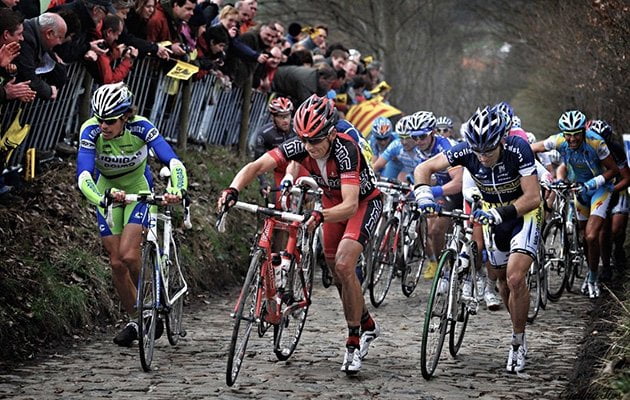
The race, also called “De Ronde,” features many key points known as Hellingen: short but extremely steep climbs with gradients of up to 20%. Many of these climbs also run over “Kasseien” (cobblestones), which makes the route even more difficult.
This turns the Ronde into one of the toughest and most exciting cycling races of all. Crosswinds, positioning in the peloton with tactical instinct and a bit of elbowing, as well as teamwork characterize the sections before the Hellingen, in order to reach these obstacles in the best possible position. The field thins out more and more over the course of the race until, in the end, the remaining specialists fight a hard individual battle. Several riders have already won the race three times, but no one more often. These record winners include Mathieu Van der Poel as well as Fabian Cancellara, who will be standing at the roadside this year as team manager of Tudor Pro Cycling.
The 2026 Tour of Flanders will take place on April 5, 2026.
This year, two men can make history. Pogačar can move into the elite group of three-time winners, while Van der Poel could become the sole record holder with a fourth title. Both athletes are motivated to the core and will go all-in.
Review 2025 Tour of Flanders
Pogačar conjures up a victory
What a day, what a race! Tadej Pogačar celebrated a magnificent victory at the 109th Tour of Flanders. Around 25 kilometers before the finish, the world champion launched the decisive attack on the Oude Kwaremont—and nobody could match it. He rolled across the finish line in Oudenaarde with over a minute’s advantage.
Behind him, a thrilling sprint for second place unfolded, which Mads Pedersen (Lidl-Trek) won narrowly ahead of Mathieu van der Poel (Alpecin-Deceuninck). The Dutchman had previously mounted a strong comeback after a crash. Wout van Aert (VISMA | Lease a Bike) finished fourth, and Jasper Stuyven (Lidl-Trek) rounded out the top five.
Despite—and honestly also because of—crashes, chaos, and hard headwinds, it was a feast for all cycling fans, with an outstanding winner who made history in the rainbow jersey. Pogačar proved once again: when he goes, all you can do is marvel.
Paris–Roubaix Hauts-de-France
Paris–Roubaix, the Hell of the North—this nickname was originally earned because the race ran through regions of France devastated and destroyed by the First World War. Today, the notorious cobblestones and often harsh conditions give the nickname further justification. At the 118th edition of the race in 2021, riders were sometimes so covered in mud that jersey and face were barely recognizable. The next edition of Paris–Roubaix on April 12, 2026 should definitely be marked in your calendar! Many rank the race above any other one-day race, which is why it is also known as the Queen of the Classics. The cobbled sectors are classified with stars indicating how difficult each section is. The Carrefour de l’Arbre and the Forest of Arenberg are equally feared and race-deciding with their five stars.
The race finishes in the historic velodrome in Roubaix, where athletes must complete two more laps before being released from their suffering. Afterwards, using the nearly one-hundred-year-old showers of the velodrome is a tradition and one of the greatest honors of the sport—reserved only for finishers!
To prevent the cobblestones from becoming too slippery and unrideable, they must be cleared of grass before the race. Since mowing machines cannot reach into the gaps between the stones, sheep that eat the grass have become perhaps the most important “employees” in the preparations.
2026: New name, new course:
This year brings several changes to the race. For the first time, integrating a title sponsor is necessary for financing. The French region “Hauts-de-France” has secured this privilege for the coming years, and the race will therefore carry the name “Paris–Roubaix Hauts-de-France” for the time being. In addition, you should tune in a bit earlier than usual this year. The organizers want to force an early selection and therefore place four cobbled sectors in quick succession after around 100 km. Such density has never existed before and will tear the field into small groups.
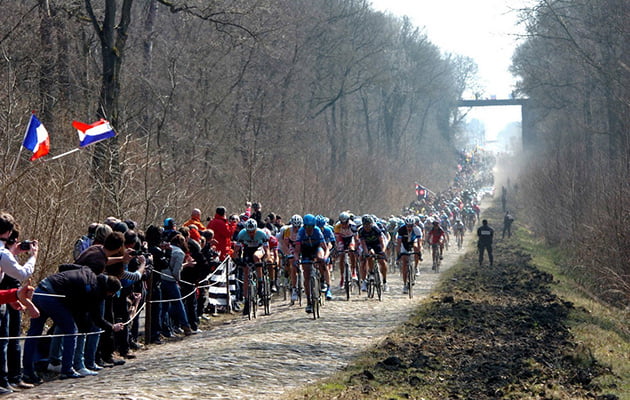
Review 2025 Paris–Roubaix
Van der Poel crowns himself King of Hell!
What a spectacle! Mathieu van der Poel made history in impressive fashion at the 122nd Paris–Roubaix, winning the “Hell of the North” for the third time in a row— a triumph for eternity! With a powerful solo over the final kilometers, the Dutchman left no doubt: this Monument belongs to him!
Over 259.2 kilometers—packed with 29 brutal cobbled sectors—van der Poel controlled the race, always alert, always ready. When the competition hesitated, he went mercilessly clear. In the end, he rolled into the legendary Roubaix velodrome with more than a minute’s advantage—cheering, beaming, like a king!
Tadej Pogačar, who had triumphed at the Tour of Flanders just a week earlier, delivered a strong performance in his Roubaix debut. Despite a crash and a bike change, he fought his way back to take second place—but on that day, nothing could be done against van der Poel.
Mads Pedersen won the thrilling sprint for third ahead of Wout van Aert and Florian Vermeersch. And from a German perspective, a highlight: Jonas Rutsch finished with a strong sixth place—his best Roubaix result to date!
An epic race, an outstanding winner. Mathieu van der Poel didn’t just win Paris–Roubaix—he ruled it!
Liège–Bastogne–Liège
The oldest one-day race still being held has truly earned the nickname “la Doyenne” (“the Old Lady”). At the same time, it is considered a particularly tough race: the Walloon Ardennes offer hard and notorious climbs, which will certainly challenge the riders again at the next edition of Liège–Bastogne–Liège on April 26, 2026! With over 4,500 meters of elevation gain, it feels more like high mountains than a race in Belgium, which is why it is often decided by lighter climbing specialists who can ride away on the hills. In recent years, the climb “La Redoute” has been especially decisive, repeatedly setting up the race in a furious pace. The record winner of this race—as so often—is Eddy Merckx, whose monument is even passed along the route.
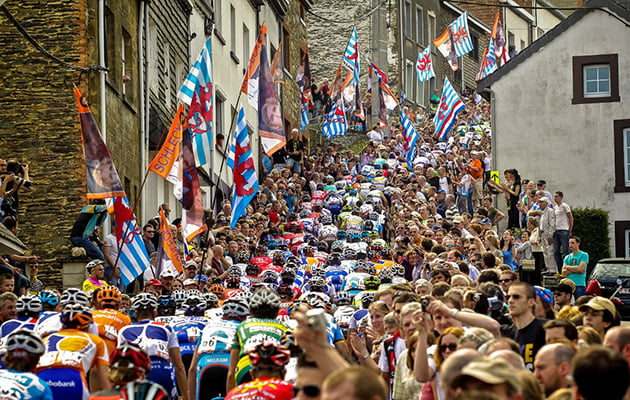
Review 2025 Liège–Bastogne–Liège
Pogačar’s triumph and a look ahead
On April 27, 2025, Tadej Pogačar enchanted the cycling world with a world-class performance! In the 111th edition of Liège–Bastogne–Liège, the Slovenian superstar launched his attack on the Côte de La Redoute 35 kilometers from the finish—and nobody could follow. With an impressive solo ride, the rider from UAE Team Emirates secured his third victory at this Monument, crossing the finish line more than a minute ahead of his chasers.
In second place, Italy’s Giulio Ciccone of Lidl-Trek battled to the line, closely followed by Irish talent Ben Healy of EF Education-EasyPost, who took third. A high-class podium—yet nobody came close to matching Pogačar’s dominance that day!
And it goes on: after a dream spring in which Pogačar already won Strade Bianche, the Tour of Flanders, and La Flèche Wallonne, the champion is taking only a short break. Soon his focus turns to the Tour de France—the next major goal! The cycling world is buzzing: will Pogačar write history there as well and further cement his legendary status? Everything suggests we will see many more magical moments from this extraordinary athlete.
Tour of Lombardy
First held in 1905 and known as the “Giro di Lombardia” from 1907 to 2012, the one-day race is officially called “Il Lombardia” today. The Tour of Lombardy is traditionally the last big race of a cycling season and the only one of the Monuments not held in spring, which is why it has earned the nickname “Race of the Falling Leaves.” Unlike the other Monuments, the race changes its direction every year. Como and Bergamo alternate as start and finish locations, meaning each year features a completely different route. Alongside the beautiful lakes, the race is shaped by the Alpine foothills. It is the only Monument that truly includes mountains, reaching just over 1,000 meters. If the finish is in Bergamo, the Passo di Ganda is considered the main executioner; if the finish is in Como, there are various options for the final climbs. The Madonna di Ghisallo climb has special significance: she is the patron saint of cyclists, and at the summit there is a chapel where dozens of jerseys from legends of the sport hang—left in thanks for their successes at the Madonna. Because of its late date in the calendar, many riders see the race as the perfect occasion for the final race of their careers, meaning the winner is sometimes overshadowed by those images—and many fans struggle to hold back tears.
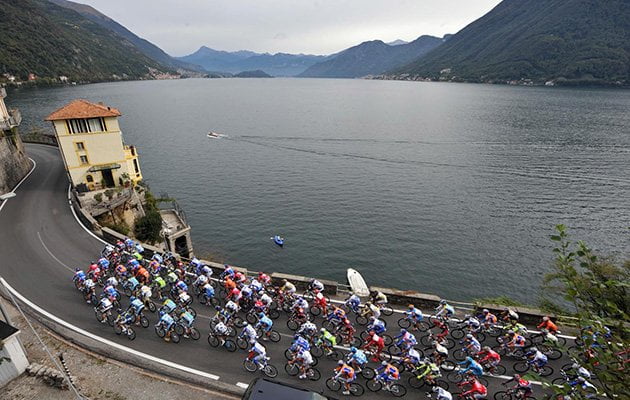
Review 2025 Tour of Lombardy
Tadej Pogačar triumphs again at the Tour of Lombardy
To close an impressive season, Tadej Pogačar delivered another statement at the 119th Tour of Lombardy on October 11, 2025. Wearing the rainbow jersey of the reigning world champion, the Slovenian dominated the race and celebrated his fifth consecutive victory at “Il Lombardia.” No one has won the race as often as the Slovenian—and given the dominance on display, it is hard to believe the winning streak will not continue.
