

























A MIPS Helmet: Does Your Bicycle Helmet Need MIPS?
We have compiled the answers to these questions for you in the following overview on the topic of MIPS:
Table of Contents

- MIPS – What is it exactly?
- How does MIPS work?
- MIPS – A success story
- Spherical MIPS
- Conclusion: Helmet with or without MIPS?
- Small MIPS FAQ
MIPS – What is it exactly?
The conventional construction of helmets, not limited to bicycle helmets, traditionally assumed a fall where the head impacts linearly – a so-called Head-On Impact. However, falls in reality are rarely perfectly linear.
With increasing awareness of skull-brain injuries and their consequences, it became increasingly clear that falls with rotational movements can be very dangerous.
The Multi-directional Impact Protection System (MIPS) is designed to provide additional protection against these rotational movements:
How does MIPS work?
Imagine a fall where a rider crashes into a mountainside. It is sloping and uneven, leading to different rotational movements of the head – simultaneously! These partially opposing forces are, of course, anything but healthy, especially for the sensitive brain. To protect it, the helmet should absorb the impact forces as effectively as possible, thus safeguarding the head.
Today's helmets made of EPS foam provide this protection by allowing the material to compress during a fall, absorbing the impact energy in the process. That's why it is always important to never reuse a helmet that you've already fallen with!
To provide enough impact protection, the hard and protective shell of a bicycle helmet must be rigid and robust and, therefore, cannot cushion rotational movements. This is where MIPS comes into play:
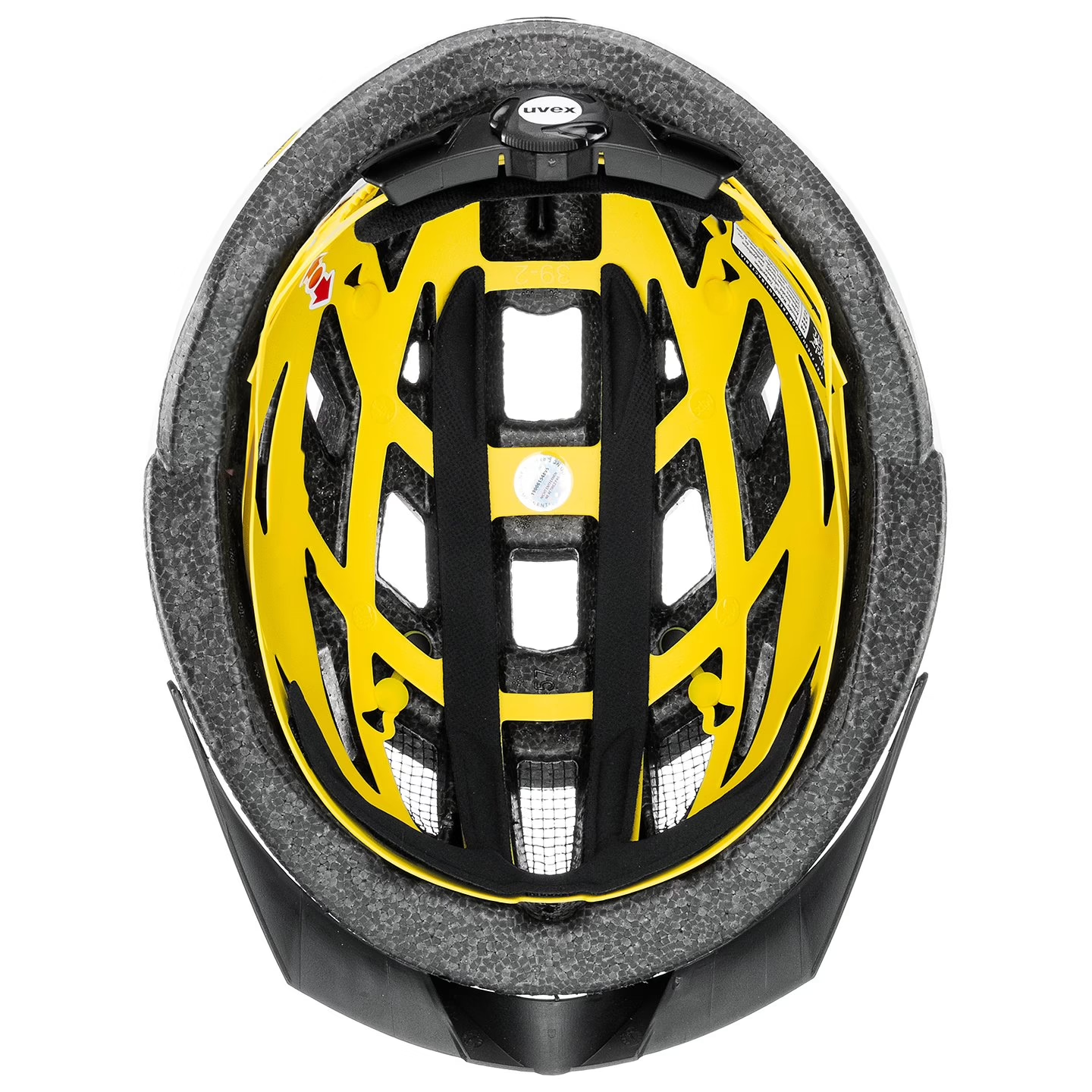
Attached between the inner padding and the EPS foam, it resembles a shell between the helmet and the head.
This shell, also referred to as the Slip-Plane or Glide Layer, can move in multiple directions during an oblique impact. Ideally, the system completely absorbs this rotational movement without transferring it to the head – at the very least, it reduces these movements and provides additional protection.
MIPS – A Success Story
In 2024, most bicycle helmet manufacturers incorporated helmets with MIPS technology. In our online shop, you can find a wide selection of them – from regular city helmets to time trial helmets and MTB helmets, there are MIPS helmets available for all cycling disciplines.
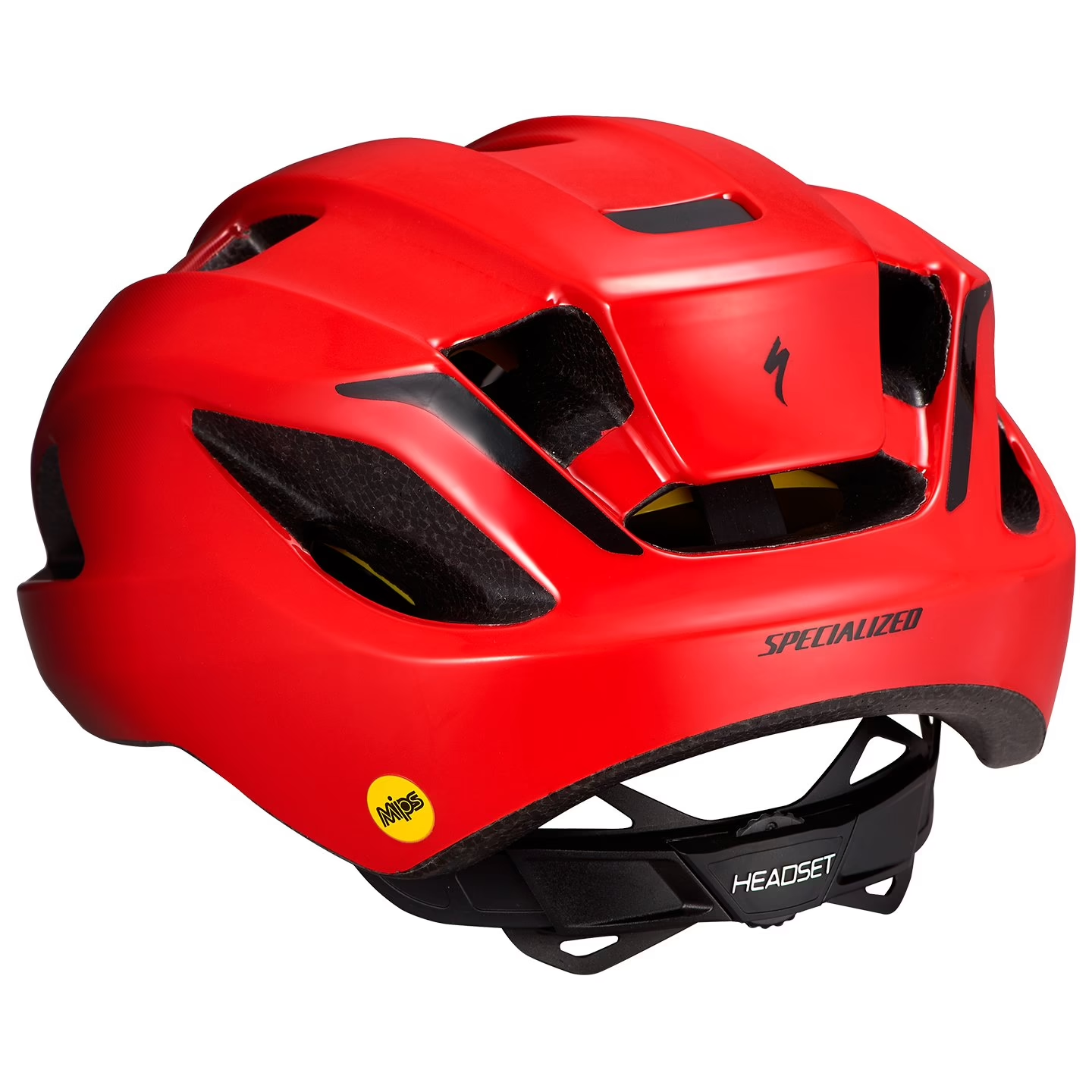
To provide some hard numbers: In 2021, 143 different manufacturers integrated MIPS into a total of 883 helmet models. The trend is clearly on the rise. MIPS helmets are used in various areas and sports, including occupational safety. In the world of cycling, MIPS has become a trendsetter.
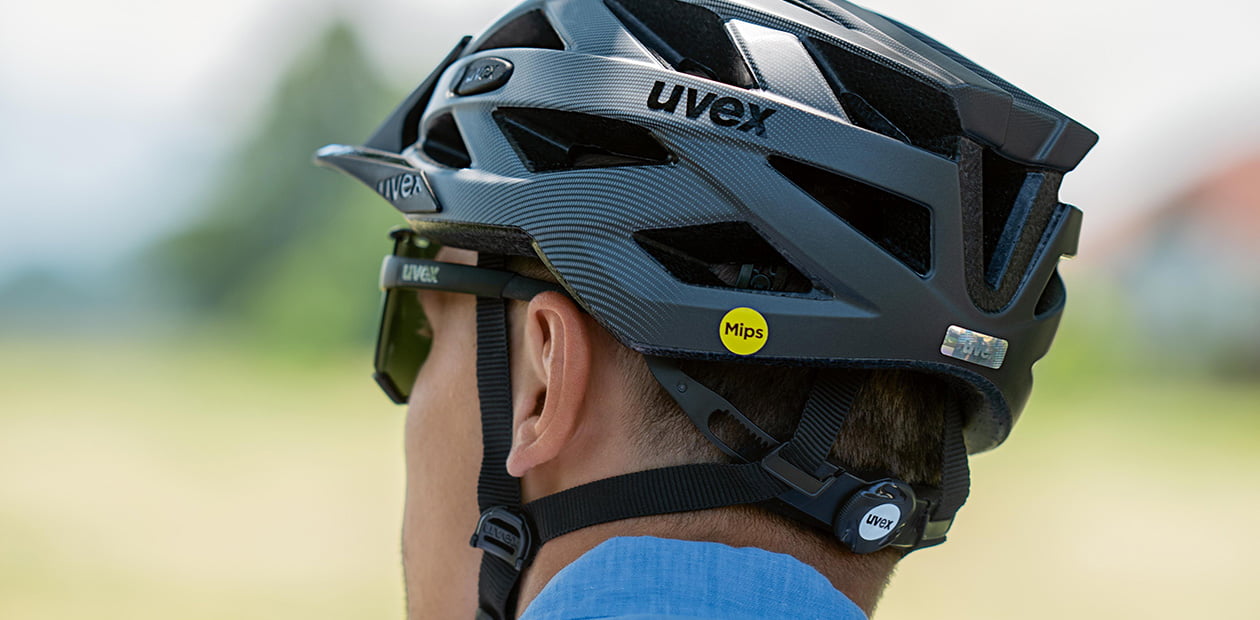
The yellow logo and the yellow protective layer inside the helmet, the "real" MIPS, are impossible to overlook. This is due to various factors. For one, it is straightforward to integrate MIPS into existing helmet models.
Most importantly, MIPS is convincing: Not only due to the solid additional protection but also because of its relatively low weight. Different MIPS variants weigh only between 20-45g, similar to an energy bar.
You can find more about the history of MIPS and its different variants in our MIPS FAQ. However, as a bicycle helmet wearer, you don't have to go through extensive research to determine which MIPS variant is best for you. The helmet manufacturer collaborating with MIPS takes care of that to ensure the ideal integration of the glide layer into the helmet.
The variants differ only in how they are built into the helmet. However, there is a truly unique development of MIPS that works a bit differently and is quite interesting:
Giro and Bell: Spherical MIPS
Trusted helmet manufacturers Bell and Giro understand that a good bicycle helmet should not be a choice between safety and performance but must offer both. Accordingly, they invest heavily in research and design.
We, as cyclists, benefit from this: In the product lines of both brands, a very special advancement of MIPS is integrated into high-end helmets: Spherical MIPS.
One advantage of MIPS is that it can easily be inserted into existing helmets. However, the Spherical MIPS helmets from Bell and Giro also showcase the potential of helmets that plan and use the strengths of MIPS from the beginning:
Gleitebene Spherical Mips in Bewegung, HelminnenansichtIn the animation, you can see the interior of the Giro Aether MIPS. It's immediately noticeable that the classic yellow glide layer is missing.
That's because the Spherical MIPS of the Aether helmet consists of two EPS shells that absorb the majority of the impact energy during a fall while also providing very high ventilation. The unique MIPS Spherical technology is located between these two shells, with the inner shell replacing the plastic sliding surface of the standard MIPS.
Aufprallsimulation Fahrradhelm mit Spherical Mips
You can observe the result in this animation: During a fall with an oblique impact, the inner helmet shell, the MIPS Spherical, moves to absorb and mitigate the rotational movement.
Because the two EPS shells can move against each other like a joint, the helmet offers all the benefits of MIPS protection against rotational movements – additionally reinforced by the inner EPS shell. This makes the Spherical MIPS a true milestone in safety.
Conclusion: Buy a helmet with MIPS or without?
Especially if you are considering a helmet that is available with or without Mips, we strongly recommend that you buy a bike helmet with MIPS.
The protection of your head and brain is not the place to skimp – especially since the additional cost for MIPS is usually relatively low. MIPS is not a miracle solution that magically prevents injuries, but it doesn't hurt and can make a difference in the event of a fall. Perhaps even the crucial difference.
Small MIPS FAQ
Short answer: Any of them. Additional safety is always good.
The slightly longer answer: A fall can happen anytime and anywhere. Particularly in urban cycling, which is hardly the riskiest cycling discipline, most accidents occur. Therefore, additional protection is always important and correct – just make sure you choose a MIPS helmet suitable for your cycling discipline.
As briefly mentioned above, MIPS offers different versions of the system. The manufacturer selects the most suitable one for the helmet and develops it further. Roughly speaking, you can therefore expect a MIPS road bike helmet to be optimised for low weight and good ventilation. In a MIPS MTB helmet, the specific version may weigh a little more in order to offer the right protection in the event of a fall. MIPS gravel helmets are a healthy mix of aerodynamics and off-road capability.
By the way, for city cycling helmets, we can warmly recommend the Specialized Centro LED MIPS Helmet – it not only looks good but also provides good protection, especially in urban traffic. The LED light at the rear guarantees good visibility in the dark.
Unfortunately, that doesn't work. The protection system must be integrated from the beginning – alternatively, you would have to disassemble an existing helmet in a way that would irreversibly compromise its protective function. In that case, it's better to buy a new helmet with MIPS directly.
If a workshop promises to be able to "retrofit" MIPS, someone is unfortunately trying to deceive you.
In the event of a crash or if the bicycle helmet is otherwise damaged, the entire helmet must be replaced. Helmets are always made of a material that compresses in the event of a crash, absorbing the resulting forces so that the head doesn't have to. However, during this process, the material is destroyed and cannot be repaired.
A helmet with damaged material naturally provides no protection, which is why the entire helmet must be replaced. Since MIPS cannot be removed or rebuilt, reusing it is not possible. However, it's also not desirable, as the system can also be damaged in the event of a crash.
A proven rule of thumb is to replace bicycle helmets approximately every three to five years, even if they appear undamaged. Invisible damage or material fatigue due to heat, sweat, and UV radiation cannot be identified but can reduce the protective factor in the event of a fall. MIPS does not change this rule of thumb. It is neither more nor less sensitive to the natural passage of time than the other materials that make up a helmet.
MIPS operates entirely automatically. When you wear your MIPS helmet, the system comes into play automatically in the event of a fall. The process is completely mechanical and therefore does not require electronics, batteries, or the like. It's that simple.
No. MIPS does not change the fit of the helmets. Regarding size, you should buy a MIPS helmet just like a helmet without MIPS. You can find out more about the correct fit and size of the helmet here.
There is no direct alternative to MIPS that truly convinces. The manufacturer POC has marketed a similar system in recent years called SPIN technology. A helmet with SPIN also offers an additional sliding layer, but it is integrated into the helmet padding. After several years of debate about "MIPS vs. SPIN," POC effectively settled the discussion: New helmet models from the Swedish manufacturer are now exclusively made with MIPS and no longer with SPIN.
However, this doesn't mean that MIPS is entirely the only option. For example, Bontrager manufactures helmets with Wavecell material, which also protect against rotational forces. Unlike MIPS, the protection here doesn't come from an additional sliding layer but from the way the high-quality material deforms upon impact.
Rotational falls are also a significant focus of research. Exciting and protective discoveries and advancements are expected in the future.
The now widely established MIPS system traces back to Hans von Holst, a Swedish neurosurgeon and Professor Emeritus at the Royal Institute of Technology in Stockholm, Sweden. Together with Peter Halldin, they conducted research on the connection between head-brain injuries and helmet designs even before the turn of the millennium.
The conventional construction of helmets, not limited to bicycle helmets, traditionally assumed a fall where the head impacts linearly - a so-called Head-On Impact. However, falls are rarely perfectly linear in reality.
After many years of research, experiments, and testing, MIPS was finally introduced in 2010: the Multi-directional Impact Protection System. This system is designed to provide additional protection during oblique impacts and falls.
If you're now wondering if you need to research the various MIPS variants to find the right one - no, you don't. But it's certainly interesting to have an overview:
The MIPS brand is what's called an Ingredient Brand: MIPS doesn't manufacture helmets itself but sells its advanced technology to other helmet manufacturers. This collaboration leads to exciting new innovations. There are many sub-variants that differ only slightly in their integration into the helmet. The MIPS company distinguishes between general sub-variants:
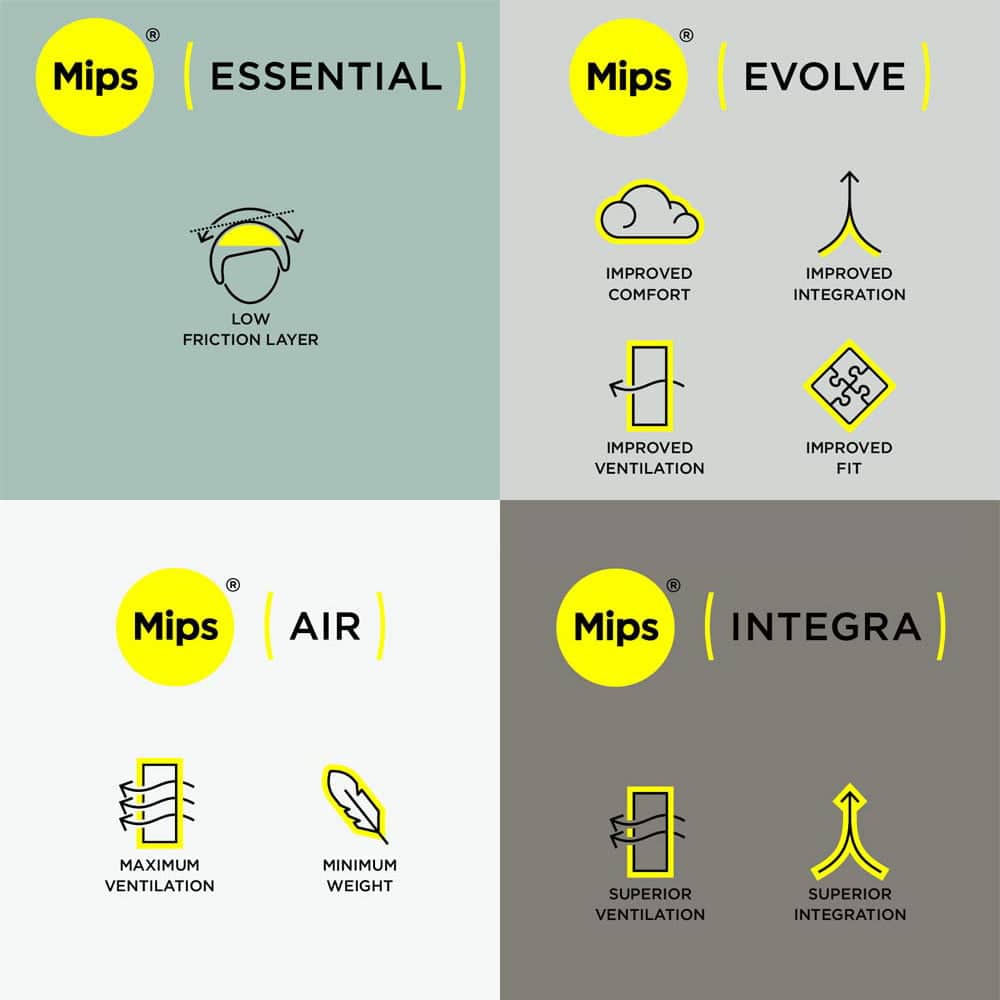
• Mips Essential: The basic variant. It can be integrated into a new helmet with little effort using injection molding. Therefore, many proven helmet models are modernized with this MIPS by manufacturers without the need for a complete redesign.
• Mips Evolve: Special focus on optimized fit and comfort.
• Mips Air: Focuses on maximum ventilation with minimal weight.
• Mips Integra: The helmet is designed entirely with MIPS in mind and optimized for it. As a result, the system can be accommodated as space-efficient and breathable as possible. However, designing a new helmet from scratch is a significantly more complex process than simply adding MIPS to an existing helmet model. A good example of this variant is the MIPS SW from Specialized, which is integrated into helmets such as the S-Works Road Helmet Prevail III.
